
New Research on COVID’s Impact on Substance Use Policies
A new publication as well as a new research project advocate for the need to relax restrictions to save lives.
Amid the tragedy and heartbreak of the COVID-19 pandemic, there have also been positive societal and health outcomes. One such positive health outcome is the acceleration of telehealth services, allowing people who desperately need medications to receive them without the barrier of an in-person visit.
The staff at SIG have been at the forefront of calls to loosen restrictions around in-person requirements for medicine, specifically life-saving medications used to treat opioid use disorder. Now, a new publication as well as a new research project advocate for the need to relax restrictions to save lives.
New publication
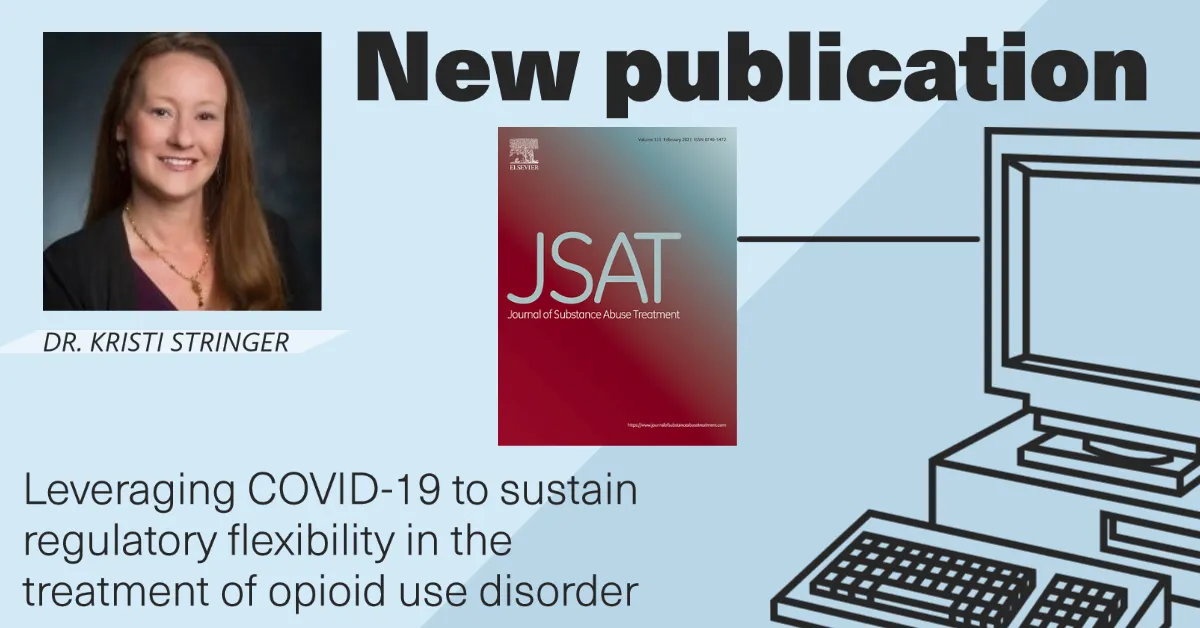
Leveraging COVID-19 to sustain regulatory flexibility in the treatment of opioid use disorder
Dr. Kristi Lynn Stringer, PhD, a T32 Postdoctoral fellow, has just published research along with former T32 Fellow Dr. Phillip Marotta, and colleagues from Brown University including Drs. Kirsten J. Langdon, Michelle McKenzie, and Brad Brockman.
Of the research, Dr. Stringer says
The stigma associated with drug use, particularly heroin and other opioids, has resulted in policies that systematically discriminate against people who use drugs which makes accessing treatment unnecessarily burdensome.
Dr. Stringer continues: “COVID has accomplished in a matter of months what scientists and providers have been trying to do for years: Remove some of these cumbersome barriers. COVID has allowed greater flexibility to initiate MOUD via telehealth platforms, resulting in improved access to care.”
Read the publication: Leveraging COVID-19 to sustain regulatory flexibility in the treatment of opioid use disorder
New research project
COVID-19 Impact on Substance Use Policies
Several SIG staff and colleagues from Columbia University joined efforts and launched a new study, as part of the newly formed CHOSEN Center, to loosen federal regulations for addiction services delivery during COVID-19 and generate data to inform post-emergency policy-making.
In response to the COVID-19 pandemic, researchers wish to understand the development, implementation, and impact of substance use policy changes on organizations, providers and consumers of substance use services. To promote social distancing, policy changes encouraged the use of telehealth, increased dosing of medications for substance use disorders, and expanded provider scope of practice.
In partnership with OASAS, researchers from the team have applied mixed methods to conduct two waves of qualitative interviews of policymakers and providers. The Team is also conducting a survey of substance use services organizations. Results of the Study will inform future policy and clinical best practices.
Read more about the research scientists involved with this project.
Follow SIG's work by signing up for our monthly newsletter or following us on Twitter.