
Groundbreaking University Seminar Brings Together Experts to Explore AI for Social Good and Society
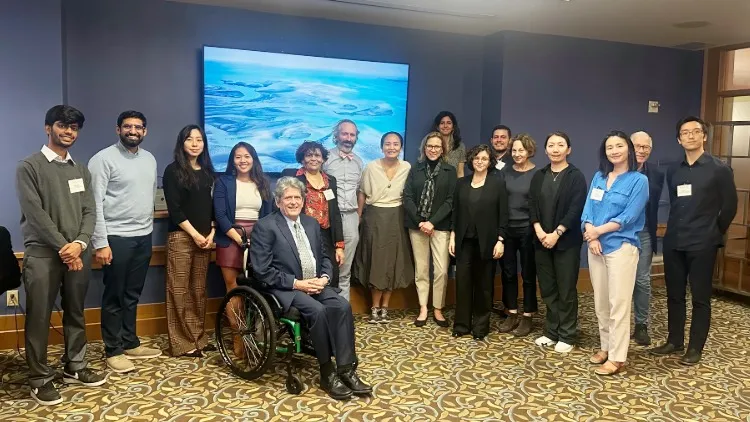
On May 5, 2026, Drs. Nabila El-Bassel and Tian Zheng launched a new and dynamic University Seminar at Columbia University, Artificial Intelligence for Social Good and Society. Bringing together leading minds from industry, research, academia, local government, and community, the Seminar will promote ethical, equitable, and justice-driven AI to address societal problems. As part of its initial productivity, the Seminar will produce a special issue focused on AI for Social Good and Society.
Drs. El-Bassel and Zheng also co-founded and spearhead the university-wide AI for Social Good and Society (AI4SGS) initiative. It is housed in the Columbia School of Social Work’s Social Intervention Group. AI4SGS was established in 2025 to bring together experts from fields around the university in order to apply artificial intelligence to some of the world’s most pressing social and public health challenges. In the past year, AI4SGS has established a series of workshops about the role of AI in healthcare, offered a class in AI in Community-Engaged Research, and presented a model for the practical, robust, and sustainable implementation of technology and AI in community settings.
Building on the 80 years of history of Columbia’s University Seminars and deepening the work of AI4SGS, AI for Social Good and Society is guided by expert multidisciplinary researchers and community leaders who will emphasize community engagement and participatory, community-driven AI design and approaches. During the first meeting of the Seminar, guest speaker Xi Song, a professor of sociology at Columbia, discussed how LLMs can be used to improve social science researchers’ data about occupations, allowing for better understanding of the labor market and emerging forms of inequality.
“The AI for Social Good and Society University Seminar reflects our commitment to ensuring that artificial intelligence is not only technically innovative, but also ethically grounded, community-centered, and directed toward justice. This University Seminar creates an important forum for faculty, scholars, practitioners, industry leaders, government partners, and community members to come together to advance the responsible use of AI in addressing urgent social and public health challenges while promoting equity and human dignity,” said Dr. Nabila El-Bassel, University Professor at Columbia University.
Born of the idea of creating ongoing groups of Columbia professors and experts from the region to explore matters no single department had the breadth or the agility to study, the first five University Seminars were established in 1944. Of those initial five, two continue to this day: Studies in Religion, and The Renaissance. When the University Seminars were initially conceived, then-Columbia President Nicholas Murray Butler imagined them as a quick way to mobilize the intellectual resources of the University to confront suddenly emerging problems, a tradition in which AI for Social Good and Society exists.
AI for Social Good and Society has 25 registered seminar members, including neuroscience, social work, and computer science researchers as well as corporate and nonprofit executives, and everything in between. Their diverse backgrounds and perspectives create an environment ripe for the discussion of complex, multifaceted ideas and building a deeper understanding of what AI can do to improve our strategies for addressing pressing societal issues.
Seminar members: Arjun Balaji, McKynzie Clark, Melissa Begg, Eric Aragundi, Xuhai Xu, Ping Ji, Mark Weckel, David Rothschild, Noémie Elhadad, Lily Xu, James David, Yaren Bilge Kaya, Bruce Usher, Xia Zhou, Takahiro Yabe, Yunyu Xiao, Nikhil Garg, Jeffrey Lancaster, Vivian Trakinski, Matthew Connelly, Joseph Howley, Dennis Yi Tenen, John Mann, Bob Massie, and Xi Song.