The Social Intervention Group at Columbia University School of Social Work recently published a new study in Social Science & Medicine, which is among the first to examine the lived experiences of LGBTQ+ individuals with diverse gender expressions at a national scale in China.
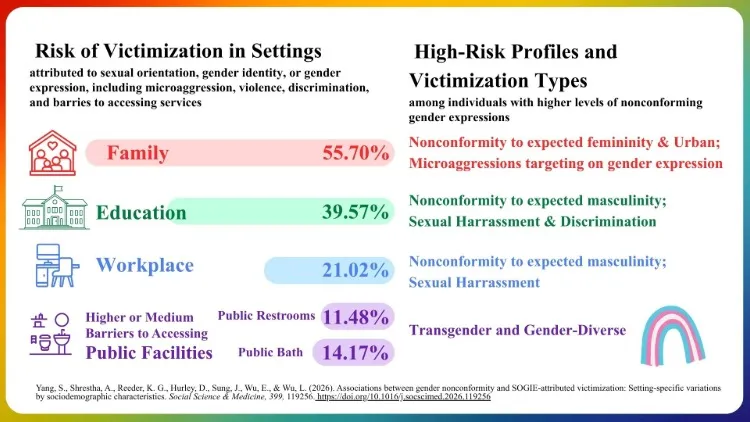
The study examined the associations between gender nonconformity (i.e., when an individual’s gender expression does not conform to socially expected femininity or masculinity, such as being considered “effeminate” or “tomboyish”) and victimization attributed to sexual orientation, gender identity, or gender expression (SOGIE), including discrimination, violence, and barriers to accessing public services in seven different social contexts.
Key Findings:
- In family, school, and workplace settings, higher levels of gender nonconformity were significantly associated with greater risk of victimization.
- Gender nonconformity showed significantly positive associations with barriers when accessing public restrooms and bathing facilities; compared to the cisgender population, such associations were stronger among transgender and gender-diverse individuals.
- Within families, nonconformity to expected femininity showed a stronger association with microaggressions explicitly targeting gender expression; in schools and workplaces, nonconformity to expected masculinity showed a stronger effect on the risk of sexual harassment.
- Among transgender and gender-diverse individuals and those with greater outness (identity revealment), the association between gender nonconformity and victimization risk appeared weaker in the family and educational settings.
- Compared to individuals with rural household registration (hukou), the association between gender nonconformity and victimization within families was stronger among those with urban hukou.
As the types of gender nonconformity-associated victimization showed descriptively distinct patterns across social contexts, this study laid an empirical foundation for future research to further examine the potential contextual factors, such as interpersonal dynamics and power structures embedded in different institutional contexts, that may shape how gender nonconformity is responded to.
While taking into account cultural factors, the research team suggested that future studies should draw on postmodernism and critical queer theory, and should reject the essentialist or the Oriental account that sees gender discipline as a unique phenomenon in Eastern cultures. “We believe that as the next step, research may examine how culture is mobilized through modern institutional power and arrangements to reproduce cisheteronormativity and regulate queer bodies," said Yang Shichang, Doctoral Research Assistant at SIG and lead author of the article.
Read the full paper in Social Science & Medicine.